
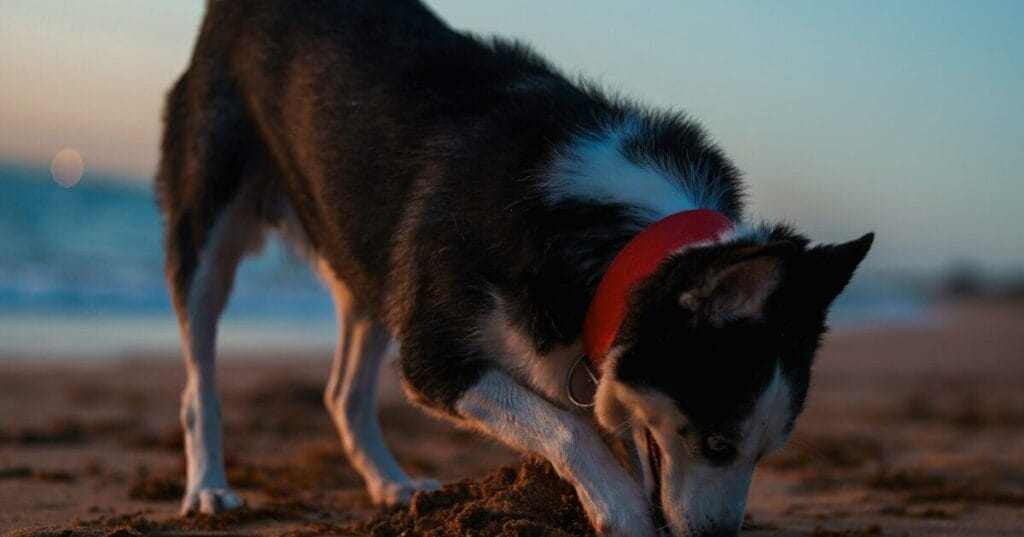
If your dog occasionally takes a mouthful of soil while sniffing, digging, or exploring the yard, it may be simple curiosity. But frequent, intense, or sudden dirt eating can sometimes point to boredom, stress, gastrointestinal problems, anemia, nutritional imbalance, or another medical issue.
Table of Contents
Eating soil is sometimes called geophagia. When a dog repeatedly eats dirt or other nonfood objects, the behavior may fall under pica, which is the persistent ingestion of nonfood materials. Pica can have behavioral or medical causes and should not automatically be blamed on a vitamin or mineral deficiency.
The most important questions are how often your dog eats dirt, how much they swallow, whether the behavior is new, and whether you are seeing other symptoms such as vomiting, diarrhea, weight loss, pale gums, or abdominal discomfort.
Why does my dog eat dirt?
There is no single explanation for dirt eating in dogs. Some dogs investigate soil because it smells interesting, while others may eat it because they are bored or anxious. Persistent dirt eating can also occur alongside medical conditions.
Common possibilities include:
- Curiosity and normal exploration
- Boredom or insufficient stimulation
- Stress or anxiety
- Attention-seeking behavior
- Hunger
- Gastrointestinal problems
- Anemia
- Nutritional imbalance or malnutrition
- Intestinal parasites or other medical conditions
- Compulsive behavior
- Attraction to fertilizer, compost, food residue, or other smells in the soil
The American Kennel Club notes that repeated dirt eating can be associated with behavioral, nutritional, and physical causes, including stress, gastrointestinal problems, and anemia. (American Kennel Club)
1. Your dog is exploring the environment
Dogs investigate the world with their noses and mouths. Dirt can contain hundreds of interesting smells from plants, wildlife, food, insects, other animals, and decomposing organic matter.
Puppies are particularly likely to explore objects by chewing and mouthing them.
A dog that briefly tastes some soil while digging and then moves on may simply be investigating its environment.
The behavior becomes more concerning when your dog:
- Deliberately searches for dirt to eat
- Swallows large amounts
- Eats dirt every day
- Becomes difficult to interrupt
- Eats other nonfood materials as well
- Suddenly develops the behavior after previously ignoring soil
Persistent ingestion is more consistent with pica than simple exploration.
2. Boredom may encourage dirt eating
Dogs need more than physical exercise. They also need opportunities to sniff, explore, play, chew, solve problems, and interact with people.
A bored dog left alone in a yard may begin digging and eventually start chewing or swallowing the soil.
Other possible signs of insufficient stimulation include:
- Excessive digging
- Destructive chewing
- Constant attention seeking
- Repetitive barking
- Stealing household objects
- Pacing
- Getting into the trash
- Finding inappropriate things to eat
The AKC identifies boredom and lack of enrichment among behavioral factors that can contribute to pica. (American Kennel Club)
If digging seems to be part of the problem, DogsScope’s guide to stopping a puppy from digging covers environmental enrichment, redirection, and other approaches for managing the behavior.
Adding sniffing walks, food puzzles, safe chew toys, short training sessions, fetch, hide-and-seek games, and supervised outdoor play may reduce dirt eating when boredom is contributing.
3. Stress or anxiety can contribute to pica
Some dogs develop unusual or repetitive behaviors when they are stressed.
Possible triggers include:
- Moving to a new home
- Changes in routine
- Being left alone
- A new pet or family member
- Loud construction
- Fireworks
- Thunderstorms
- Conflict with another dog
- Long periods without interaction
An anxious dog may also pace, pant when it is not hot, tremble, hide, vocalize, become unusually clingy, or struggle to settle.
However, dirt eating should not automatically be diagnosed as anxiety. VCA Animal Hospitals lists both behavioral and medical conditions among possible causes of pica, including gastrointestinal disease, anemia, malnutrition, diabetes, intestinal parasites, and anxiety. (Vca)
Medical causes should be considered when dirt eating is persistent or new.
4. Your dog may have learned that eating dirt gets attention
Dogs are excellent at discovering which behaviors make their owners react.
Imagine that your dog puts dirt in their mouth and you immediately run over, speak excitedly, chase them, or offer a treat in exchange for dropping it.
Your intention is to stop the behavior, but your dog may learn:
Eat dirt = owner gives me attention.
That can unintentionally reinforce the habit.
This does not mean you should ignore dirt eating when your dog’s health could be involved. Once medical problems have been considered, training can focus on rewarding more appropriate behaviors.
Positive reinforcement and cues such as “leave it” and “drop it” rather than punishment when managing pica.
5. Gastrointestinal problems may play a role
Some dogs with gastrointestinal problems develop unusual eating behaviors.
Several gastrointestinal conditions among possible medical causes of pica, including inflammatory bowel disease, intestinal parasites, liver shunts, and exocrine pancreatic insufficiency.
That does not mean dirt eating proves that your dog has digestive disease.
Look for additional symptoms such as:
- Vomiting
- Diarrhea
- Changes in stool
- Reduced appetite
- Weight loss
- Excessive gas
- Abdominal discomfort
- Lethargy
- Increased or decreased appetite
Monitoring changes in bowel habits can provide useful information. DogsScope’s Dog Poop Calculator provides general information about bowel-movement frequency, although persistent diarrhea, constipation, blood in the stool, or other significant changes should be discussed with your veterinarian.
6. Anemia can sometimes be associated with dirt eating
One reason persistent dirt eating deserves attention is that pica may occur alongside anemia, which means the blood has an abnormally low number of red blood cells or insufficient red-cell mass.
Both AKC and VCA include anemia among medical conditions that can be associated with pica. (American Kennel Club)
Possible signs of anemia can include:
- Pale gums
- Weakness
- Unusual tiredness
- Reduced exercise tolerance
- Rapid breathing
- Collapse in severe cases
Dirt eating alone cannot tell you whether your dog is anemic. A veterinarian may recommend blood testing when the dog’s history and physical examination make anemia or another medical condition a concern.
7. Does eating dirt mean my dog has a nutritional deficiency?
Possibly, but not necessarily.
Dirt eating is frequently blamed on a lack of iron, minerals, or vitamins, but there are many other causes of pica.
VCA lists malnutrition and an imbalanced diet among potential causes, while the AKC notes that nutritional deficiencies are only one possible explanation. Behavioral factors and medical conditions may also be involved. (American Kennel Club)
If your dog already eats a complete and balanced commercial diet appropriate for their life stage, do not automatically begin giving mineral or vitamin supplements.
Too much of certain nutrients can also be harmful.
Instead, talk with your veterinarian about:
- Your dog’s regular food
- Portion size
- Treats
- Supplements
- Table scraps
- Recent diet changes
- Weight and body condition
If you combine different types of dog food, DogsScope’s Mixing Wet and Dry Dog Food Calculator can help you understand the proportions you are feeding. It should not replace individualized nutritional advice from your veterinarian.
8. Hunger may encourage scavenging
Some dogs investigate soil because they are hungry or highly food-motivated.
This may be especially noticeable when soil contains:
- Food scraps
- Grease
- Compost
- Animal feces
- Bone meal
- Blood meal
- Organic fertilizer
Make sure your dog’s portions are appropriate for their age, activity level, body condition, and the calorie content of their food.
However, an unexplained increase in appetite should not simply be treated by increasing food.
Certain illnesses and medications can increase appetite. Diabetes, Cushing’s disease, and medications such as corticosteroids among conditions that may increase abnormal eating behavior.
9. Your dog may be attracted to compost or fertilizer
Sometimes it is not the dirt itself that attracts a dog.
Garden soil may contain highly appealing substances such as:
- Compost
- Manure
- Bone meal
- Blood meal
- Food waste
- Plant material
- Organic fertilizers
Some of these products can be dangerous.
The ASPCA warns that fertilizers can cause gastrointestinal irritation and, depending on the ingredients and amount consumed, potentially more serious effects. Compost can also contain substances that are unsafe for dogs.
Keep dogs away from treated garden beds and follow all product instructions regarding pet access.
For more information, see the ASPCA’s fertilizer and compost pet-safety guidance.
10. Repetitive dirt eating can become compulsive
A dog that occasionally tastes soil is very different from a dog that appears driven to eat it.
Compulsive behavior tends to be:
- Repetitive
- Difficult to interrupt
- Excessive for the situation
- Persistent even when there is no obvious reward
- Interfering with normal activities
The AKC describes canine compulsive disorders as repetitive behaviors that become difficult for the dog to stop and can interfere with normal functioning; excessive dirt eating can be one example. (American Kennel Club)
Before treating dirt eating as a purely behavioral problem, veterinarians generally need to consider potential medical causes.
Is eating dirt dangerous for dogs?
It can be.
The risks depend on what is in the soil, how much your dog swallows, and whether they ingest rocks or other material along with it.
Intestinal blockage or impaction
Large quantities of dirt, sand, rocks, or other foreign material may accumulate in the gastrointestinal tract.
An obstruction can cause:
- Vomiting
- Loss of appetite
- Lethargy
- Abdominal pain
- Abdominal swelling
- Dehydration
- Difficulty passing stool
Merck Veterinary Manual explains that gastrointestinal obstruction can become an emergency and may lead to serious complications if material cannot pass through the digestive tract.
Parasites
Soil contaminated by animal feces may contain parasite eggs, larvae, or other infectious material.
Eating soil therefore creates a potential exposure route, particularly when dogs consume dirt from areas frequented by other animals.
This does not mean a dog will automatically get parasites from tasting dirt, but repeated ingestion increases opportunities for exposure.
Pesticides and fertilizers
Soil can contain herbicides, pesticides, rodenticides, fertilizers, or other garden chemicals.
The ASPCA recommends keeping pets away from potentially hazardous lawn and garden products and following the manufacturer’s directions carefully. (ASPCA)
Rocks and sharp objects
Dogs rarely separate clean soil from everything mixed into it.
They may accidentally swallow:
- Stones
- Gravel
- Sticks
- Wood fragments
- Plastic
- Metal
- Glass or other debris
Hard objects can damage teeth, while swallowed foreign material can become lodged in the gastrointestinal tract.
When should I worry about my dog eating dirt?
An occasional small taste of untreated soil in an otherwise healthy dog may not necessarily be an emergency.
You should pay closer attention when dirt eating is:
- New
- Frequent
- Increasing
- Difficult to interrupt
- Frantic or unusually intense
- Happening every day
- Involving significant amounts of soil
The AKC specifically recommends veterinary attention when dirt eating becomes frequent, intense, or involves large quantities. (American Kennel Club)
Contact your veterinarian if dirt eating occurs alongside:
- Vomiting
- Diarrhea
- Constipation
- Loss of appetite
- Weight loss
- Pale gums
- Weakness
- Excessive tiredness
- Abdominal pain
- Abdominal swelling
- Significant changes in thirst
- Significant changes in appetite
- Blood in vomit or stool
- Repeated ingestion of other nonfood items
Seek urgent veterinary advice if your dog has eaten soil containing a suspected toxin, fertilizer, pesticide, rodent poison, sharp object, or a substantial amount of sand or foreign material.
Why does my puppy eat dirt?
Puppies naturally explore their surroundings with their mouths, so occasional investigation of dirt is not unusual.
They may also discover soil while digging, playing, or teething.
However, puppies should not routinely be allowed to swallow dirt. Their smaller size means that rocks and other foreign objects can potentially cause problems with relatively small amounts.
Puppies are also still developing their habits, so repeated dirt eating is easier to address before it becomes established.
Supervise your puppy outdoors and work on cues such as:
- “Leave it”
- “Drop it”
- Recall
- Moving away from tempting areas
Provide safe chew toys and plenty of appropriate opportunities to sniff, play, and explore.
Why does my dog eat dirt from houseplants?
Houseplant soil may be more interesting than ordinary yard dirt because it can contain:
- Fertilizer
- Compost
- Organic material
- Plant roots
- Moisture
- Interesting scents
The plant itself may also be a concern.
Some common houseplants are toxic to dogs, and fertilizers or additives in potting mixtures can create additional risks.
If your dog repeatedly targets houseplants, move the pots somewhere inaccessible until you understand why the behavior is happening.
If you believe your dog ate a potentially toxic plant or garden product, contact your veterinarian or an animal poison-control service.
What should I do if my dog keeps eating dirt?
Prevent access temporarily
Supervise outdoor time and use a leash if necessary.
Fence off areas where your dog regularly eats soil, particularly:
- Compost piles
- Fertilized beds
- Recently treated lawns
- Construction areas
- Areas containing sharp debris
Improve mental and physical enrichment
Provide regular opportunities for:
- Walking
- Sniffing
- Training
- Fetch
- Tug
- Food puzzles
- Appropriate chewing
- Social interaction
This is particularly useful when boredom appears to contribute.
Teach “leave it”
Positive reinforcement can help your dog learn to disengage from dirt.
Begin with low-value objects indoors before gradually practicing around more tempting outdoor distractions.
Avoid harsh punishment, which can increase stress and may encourage some dogs to gulp the material quickly before you can remove it. VCA recommends reward-based training and environmental management for pica.
Review your dog’s diet
Make sure your dog is receiving a complete and balanced diet appropriate for their life stage.
Do not start iron, vitamin, or mineral supplements merely because your dog eats soil. If a nutritional deficiency is suspected, your veterinarian can determine whether testing or dietary changes are appropriate.
Watch for other changes
Pay attention to:
- Appetite
- Weight
- Energy
- Stool
- Vomiting
- Thirst
- Urination
- Gum color
- General behavior
If your dog has several unexplained health or behavioral changes, DogsScope’s Dog Quality of Life Calculator can help you think systematically about areas such as health, nutrition, exercise, comfort, and mental stimulation. It should be used as a general tool rather than a substitute for veterinary care.
What will a veterinarian do for a dog that eats dirt?
The evaluation depends on your dog’s age, symptoms, diet, and the severity of the behavior.
Your veterinarian may ask:
- When did the dirt eating begin?
- How often does it happen?
- How much soil does your dog swallow?
- Does your dog eat other nonfood items?
- What food does your dog eat?
- Has their appetite changed?
- Has their weight changed?
- Are they vomiting or having diarrhea?
- What medications are they taking?
- Could they have been exposed to fertilizer or pesticides?
A physical examination may be followed, when appropriate, by tests such as:
- Blood work
- Urinalysis
- Fecal testing
- X-rays
- Ultrasound
- Additional gastrointestinal testing
VCA notes that diagnosing pica can require investigation for underlying medical causes before focusing on behavioral treatment. (Vca)
Frequently asked questions
Is it normal for dogs to eat dirt?
A dog may occasionally taste dirt while exploring, but repeatedly swallowing soil is not something to ignore. Persistent dirt eating can be a form of pica and may have behavioral or medical causes.
Why does my dog suddenly eat dirt?
A sudden change can be related to a new smell or environmental attraction, but it may also accompany gastrointestinal discomfort, increased appetite, anemia, stress, or another medical problem. If the behavior is new and persistent, especially with additional symptoms, contact your veterinarian.
Does my dog eat dirt because of an iron deficiency?
Not necessarily. Anemia and nutritional deficiencies are possible causes of pica, but dirt eating has many other explanations. A veterinarian can perform blood tests if anemia or another deficiency is suspected.
Can eating dirt give my dog worms?
Potentially. Soil contaminated with feces can expose dogs to certain parasites. Dirt eating does not guarantee infection, but preventing repeated soil ingestion can reduce unnecessary exposure.
Why does my dog eat dirt and grass?
Dogs may investigate both grass and soil for several reasons, including normal exploration, boredom, gastrointestinal discomfort, or pica. Grass eating alone is relatively common, but repeatedly consuming dirt or multiple nonfood materials deserves closer attention. (American Kennel Club)
Should I stop my dog from eating dirt?
Yes, it is sensible to discourage regular dirt eating. Soil can contain chemicals, parasites, sharp objects, stones, and other hazards. Use supervision, environmental management, enrichment, and positive-reinforcement training rather than punishment.
What if my dog ate a small amount of dirt?
A small amount of ordinary untreated soil may cause no problem in an otherwise healthy dog. Monitor your dog for vomiting, diarrhea, abdominal discomfort, appetite changes, or unusual behavior. Contact a veterinarian if you are concerned about what was in the soil or if symptoms develop.
Is eating potting soil dangerous for dogs?
It can be. Potting mixes may contain fertilizer, compost, additives, or other ingredients that are not safe to ingest. The associated plant may also be toxic. Check the product ingredients and contact your veterinarian or poison-control service if a potentially hazardous exposure occurred.
When is eating dirt an emergency?
Seek prompt veterinary advice if your dog eats a large amount of dirt or sand, swallows rocks or sharp objects, encounters pesticides or fertilizer, repeatedly vomits, develops a painful or swollen abdomen, becomes very weak, cannot keep food or water down, or shows other severe symptoms.
Final thoughts
Dogs eat dirt for many different reasons. An occasional taste while exploring the backyard may be harmless, but persistent dirt eating deserves more attention.
Frequency and context matter. A dog that takes one mouthful while digging is very different from a dog that seeks out soil every day, consumes large amounts, or develops vomiting, weight loss, pale gums, diarrhea, abdominal pain, or other health changes.
Do not assume that your dog simply needs more vitamins or minerals. Behavioral causes such as boredom and stress are possible, while medical problems ranging from gastrointestinal disease to anemia may also contribute.
Prevent access to unsafe soil, keep lawn and garden chemicals away from your dog, provide appropriate enrichment, and speak with your veterinarian when the behavior is frequent, sudden, intense, or accompanied by other symptoms.