
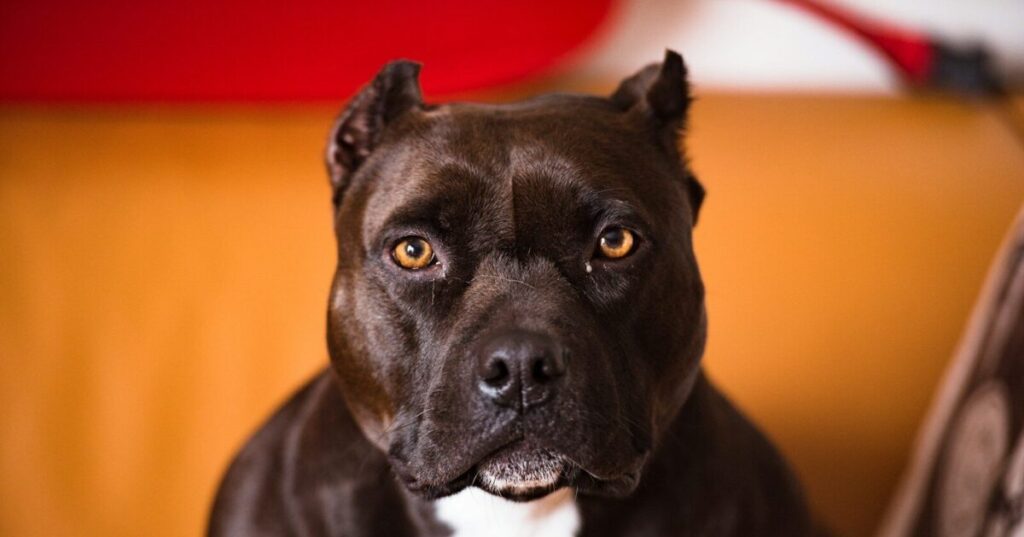
You’re sitting on the couch, working at your desk, eating dinner, or getting ready for bed when you notice it again.
Table of Contents
Your dog is staring at you.
Not just taking a quick glance. They’re watching you like you’re the most interesting thing in the room.
So, why does your dog stare at you?
In many cases, the explanation is completely normal. Your dog may be showing affection, waiting for a walk, hoping for food, looking for instructions, or simply trying to figure out what you’re going to do next.
However, not every stare means the same thing. A relaxed dog gazing at you with soft eyes is very different from a dog giving you a hard stare while standing stiffly over a food bowl.
The key is to look at your dog’s entire body language and the situation around them, not just their eyes.
The American Kennel Club explains that dogs stare at their owners for several reasons, including gathering information, communicating wants, waiting for cues, and expressing affection.
Below, we’ll break down nine of the most common reasons your dog might stare at you, what different types of staring can mean, and when the behavior may be worth discussing with your veterinarian.
Why Does My Dog Stare at Me?
The most common reasons dogs stare at their owners are:
- They feel affection and attachment toward you.
- They want something.
- They’re trying to predict what you’ll do next.
- They’ve learned that staring gets results.
- They’re waiting for instructions.
- They’re confused and looking for guidance.
- They feel anxious or uncertain.
- They’re giving a warning.
- A health or age-related problem may be involved.
Some of these reasons overlap. Your dog might stare because they love being around you and because they know you’re the person who fills the food bowl.
Context usually provides the biggest clue.
Let’s look at each possibility in more detail.
1. Your Dog Feels Affection and Attachment Toward You
Sometimes your dog stares at you for a very simple reason:
They like you.
Dogs form close social relationships with the people they live with. You provide companionship, food, safety, walks, playtime, affection, and many of the things your dog values.
It makes sense that your dog would pay close attention to you.
Affectionate staring usually looks soft rather than intense.
You might notice your dog resting beside you while quietly looking into your eyes. Their muscles are relaxed, their ears are in a natural position, and their mouth may be slightly open.
There may even be a gentle tail wag.
This type of eye contact can be part of the social bond between dogs and humans.
Research published in Science found evidence of an oxytocin-related positive feedback loop involving mutual gaze between dogs and their owners. Oxytocin is involved in social bonding in mammals.
However, that doesn’t mean every time your dog looks at you they’re declaring their undying love.
Body language still matters.
Signs your dog’s stare may be affectionate
An affectionate or relaxed stare is more likely when you see:
- Soft-looking eyes
- Relaxed facial muscles
- Loose body posture
- Relaxed ears
- Normal breathing
- A comfortable mouth
- A loose or gently wagging tail
- A dog who can easily look away and relax
If your dog calmly gazes at you while lying beside you on the couch, there’s usually no reason for concern.
They may simply enjoy your company.
Dogs that are strongly attached to their owners may also follow them from room to room. If your dog combines constant staring with following you around the house, read our guide on why dogs follow their owners everywhere for a closer look at that behavior.
2. Your Dog Wants Something
Your dog may also stare because they want you to do something.
Think about your dog’s world.
You control access to many of their favorite things.
You provide:
- Food
- Water
- Treats
- Walks
- Bathroom breaks
- Toys
- Playtime
- Car rides
- Attention
- Access to the backyard
When your dog wants one of these things, staring at you can be an effective communication strategy.
For example, your dog might stare at you and then look toward the door.
That could mean:
“I need to go outside.”
Your dog may stare at you, walk toward the kitchen, and then turn around to make sure you’re following.
That could mean:
“Isn’t it dinner time?”
Some dogs even alternate their gaze between their owner and whatever they want.
They may look at you, look at their leash, then look back at you.
The message becomes fairly obvious.
Your dog may be hungry
Food is one of the most common reasons dogs stare.
If your dog starts watching you around their usual mealtime, they may simply be waiting for dinner.
If you’re unsure how much your dog should typically be eating, you can use our How Much to Feed Your Dog Calculator as a general starting point.
Remember that feeding needs vary according to your dog’s size, age, activity level, health, body condition, and the calorie density of the food they eat. Your veterinarian can provide individualized feeding recommendations.
Your dog may be thirsty
Dogs can also try to draw attention to an empty water bowl.
Make sure your dog always has appropriate access to fresh water unless your veterinarian has specifically advised otherwise.
You can also check our Dog Water Intake Calculator for a general estimate.
A sudden, unexplained increase in thirst is different from ordinary drinking and should be taken seriously. If your dog suddenly starts drinking or urinating much more than usual, contact your veterinarian.
3. Your Dog Is Trying to Predict What You’ll Do Next
Dogs are excellent observers.
Your dog probably knows more about your daily routine than you realize.
They may recognize that:
- Putting on certain shoes means a walk is coming.
- Picking up the leash means outside time.
- Opening a particular cabinet means treats.
- Walking toward the kitchen could mean food.
- Picking up your keys means you might leave.
- Turning off the TV at night means bedtime is approaching.
- Sitting in a certain chair means cuddle time.
Your dog may stare because they’re watching for these signals.
The AKC notes that dogs often observe their owners to gather information about what is going to happen next.
Imagine that you walk your dog every evening around 6 p.m.
At 5:55, your dog walks into the room and begins watching you.
Every time you shift in your chair, their ears perk up.
You reach for your phone.
Nothing.
You stand up.
Now they’re fully alert.
You walk toward the front door.
Suddenly, your dog is dancing around the leash.
They weren’t staring randomly. They were watching for the beginning of a familiar sequence.
Dogs can become incredibly good at recognizing routines, gestures, sounds, clothing, objects, and even subtle changes in your behavior.
That’s one reason they sometimes seem to “know” what you’re about to do before you say anything.
4. Your Dog Has Learned That Staring Works
Dogs repeat behaviors that produce good results.
Sometimes owners unintentionally teach their dogs that staring is extremely effective.
Imagine this familiar situation.
You’re eating chicken at the dinner table.
Your dog sits beside you.
They stare.
You ignore them.
They stare harder.
You continue eating.
They keep staring.
Finally, you give them one tiny piece.
From your perspective, you gave your dog a small treat.
From your dog’s perspective, something much more important happened:
Staring successfully produced chicken.
Tomorrow night, your dog has every reason to try again.
The same pattern can develop with:
- Treats
- Petting
- Play
- Going outside
- Toys
- Getting on furniture
- Opening doors
- Attention
Even talking to your dog can reinforce attention-seeking behavior if attention itself is what they want.
Suppose your dog stares at you and you immediately say:
“What do you want?”
You may have just rewarded the stare with interaction.
That doesn’t mean you should never respond to your dog. Communication is important.
But if staring has become persistent begging or demanding behavior, pay attention to what happens immediately after the stare.
You may discover that the behavior keeps happening because it keeps working.
What should you do instead?
Teach an alternative behavior.
For example, instead of allowing your dog to stare at you throughout dinner, teach them to relax on a mat or dog bed.
Reward the behavior you want to see more often.
Consistency matters as well.
If three people in the household ignore begging but one person slips the dog food under the table, your dog still has a strong reason to keep trying.
5. Your Dog Is Waiting for Instructions
Some staring is actually useful.
A dog who looks toward their owner during training may be asking:
“What should I do next?”
Dogs trained with reward-based methods often learn that paying attention to their handler is valuable.
Looking at you might lead to a cue such as:
- Sit
- Stay
- Down
- Come
- Heel
- Leave it
- Wait
- Place
And successfully responding to that cue may lead to praise, food, a toy, or another reward.
This can make dogs increasingly attentive to their owners.
Voluntary check-ins are especially useful during walks and training sessions.
For example, imagine you’re walking through a park and another dog appears in the distance.
Instead of immediately pulling toward the distraction, your dog looks at you.
That moment of attention creates an opportunity for communication.
You can reward the check-in, change direction, ask for another behavior, or simply reinforce your dog for staying engaged with you.
You can teach eye contact as a behavior
A simple “watch me” or “look” cue can be useful.
Start somewhere quiet.
When your dog voluntarily looks toward your face, mark the behavior with a word such as “yes” and reward them.
Once your dog understands the pattern, you can introduce a verbal cue.
Keep sessions brief and positive.
For young puppies, learning to respond to their name is an important first step toward this kind of communication. Our guide on how to teach a puppy its name explains how to build that response.
Never physically force your dog to maintain eye contact.
Voluntary attention is far more useful than holding a dog’s face and making them look at you.
6. Your Dog Is Confused and Looking for Guidance
Sometimes a dog stares because they simply don’t understand what’s happening.
This is especially common during training.
Imagine you’re teaching your dog to lie down.
You say:
“Down.”
Your dog sits.
You repeat:
“Down.”
Your dog looks at you.
Then they offer a paw.
You say “down” again.
Now they’re staring at you intensely.
Your dog may not be refusing the command.
They may genuinely be confused.
Dogs frequently offer behaviors that have earned rewards in the past when they’re unsure what you want.
If your dog looks confused during training, repeating the same command louder usually won’t solve the problem.
Instead:
- Make the task easier.
- Return to a step your dog understands.
- Use clearer cues.
- Reward small successes.
- Keep sessions short.
- Reduce distractions.
Dogs may also look to their owners when something unfamiliar happens.
For example:
- A strange object appears in the room.
- Someone unfamiliar enters the house.
- Furniture has been moved.
- A loud sound occurs outside.
- Another animal approaches.
- You enter an unfamiliar environment.
Your dog may watch your reaction to help decide how they should respond.
7. Your Dog Feels Anxious, Nervous, or Uncertain
Staring isn’t always associated with excitement or affection.
A nervous dog may closely monitor you because they’re uncertain about what will happen next.
They may also look toward you for reassurance during stressful situations such as:
- Thunderstorms
- Fireworks
- Construction noise
- Visitors
- Veterinary appointments
- Car rides
- Travel
- Moving to a new home
- Encounters with unfamiliar dogs
- Major changes in routine
The important thing is to examine the rest of the dog.
VCA Animal Hospitals’ guide to canine communication emphasizes that canine communication involves the entire body, including the eyes, ears, facial expression, posture, tail, and vocalizations.
Possible signs of stress or anxiety
A stressed dog may show behaviors such as:
- Lip licking when food isn’t present
- Repeated yawning
- Trembling
- Panting
- Pacing
- Lowered posture
- Tucked tail
- Ears pulled back
- Trying to hide
- Turning away
- Avoiding interaction
- Freezing
- Showing the whites of the eyes
- Difficulty settling
The visible white portion around a dog’s eye is sometimes informally called whale eye when it occurs in a tense situation.
One signal alone doesn’t tell you everything.
Look for combinations.
A dog resting comfortably on the couch and briefly showing the whites of their eyes as they look sideways is different from a dog freezing over a chew while showing a tense face and whale eye.
Don’t force eye contact with an anxious dog
If your dog appears uncomfortable, forcing them to stare into your eyes can increase pressure.
Give them space and try to identify what is causing the stress.
If your dog frequently appears anxious or frightened, or their anxiety interferes with daily life, discuss the behavior with your veterinarian or a qualified canine behavior professional.
8. Your Dog Is Giving You a Warning
This is the type of stare dog owners need to recognize.
A hard stare is very different from relaxed eye contact.
A dog giving a warning may stare intensely without blinking while their entire body becomes stiff.
Other warning signs can include:
- Freezing
- Stiff posture
- Closed, tense mouth
- Growling
- Raised hackles
- Showing teeth
- Weight shifted forward
- Snapping
- Guarding an object
- Rigid tail position
If you see this combination, don’t assume your dog is simply being stubborn.
They may be communicating discomfort and asking for distance.
Resource guarding can involve staring
One common situation is resource guarding.
Imagine your dog is chewing a high-value bone.
You walk toward them.
They stop chewing.
Their body becomes stiff.
They lower their head over the bone and stare directly at you.
That stare may be a warning.
The ASPCA’s information about food and resource guarding includes staring, freezing, growling, snapping, and other behaviors among signals that may occur when a dog is guarding something valuable.
Don’t respond by challenging your dog to a staring contest or suddenly grabbing the item.
Confrontation can increase the risk of a bite.
This is especially important in homes with children.
Children may not recognize subtle warning signs and should never be expected to manage a dog that guards food, toys, sleeping areas, or other resources.
If your dog has snapped, lunged, bitten, or shown serious resource guarding, seek help from an appropriately qualified professional.
Never stare down an unfamiliar dog
Prolonged direct eye contact can be uncomfortable or threatening to some dogs.
Your own relaxed dog looking lovingly into your eyes is one situation.
Standing face-to-face and intentionally staring into the eyes of an unfamiliar, nervous, or tense dog is another.
If a dog becomes stiff and gives you an intense stare, increase distance rather than trying to prove anything.
9. Your Dog May Have a Health or Age-Related Problem
Most staring is behavioral and harmless.
However, new or unusual staring behavior can sometimes be associated with medical or age-related changes.
This is particularly important with senior dogs.
Older dogs can experience changes in:
- Vision
- Hearing
- Mobility
- Sleep
- Confidence
- Memory
- Learning
- Awareness
Some older dogs also develop canine cognitive dysfunction syndrome.
The Merck Veterinary Manual describes canine cognitive dysfunction as involving changes that may include disorientation, altered interactions, sleep-wake changes, house-soiling, anxiety, and altered activity.
A senior dog experiencing cognitive changes might:
- Stare into space
- Seem lost in familiar rooms
- Get stuck behind furniture
- Wander aimlessly
- Pace at night
- Sleep more during the day
- Wake frequently at night
- Forget previously learned routines
- Have housetraining accidents
- Become unusually clingy
- Seem confused
Staring alone does not mean your dog has cognitive dysfunction.
The concern is a change in behavior, especially when several symptoms occur together.
Unusual staring can also warrant neurological evaluation
Episodes of blank staring that are difficult to interrupt can occasionally be associated with neurological problems.
Again, don’t assume that every dog staring at a wall is having a medical emergency.
Dogs have better hearing and smell than humans and may notice things we don’t.
But contact your veterinarian if your dog suddenly develops repeated staring episodes along with symptoms such as:
- Confusion
- Trembling
- Collapse
- Unusual facial movements
- Repetitive movements
- Loss of balance
- Weakness
- Disorientation
- Major personality changes
- Difficulty responding to you
If possible, record a video of unusual episodes.
A video can sometimes provide useful information to your veterinarian.
How Can You Tell What Your Dog’s Stare Means?
The easiest way to interpret staring is to consider three things:
Body language + context + what happens next.
Consider these examples.
Example 1: The walk stare
Your dog sits beside the front door at the same time you normally go for an evening walk.
Their body is loose.
Their tail is wagging.
They look at you and then at the leash.
The likely explanation is fairly obvious:
“Can we go for our walk?”
Example 2: The affectionate stare
Your dog is lying beside you on the couch.
Their muscles are relaxed.
Their eyes look soft.
They quietly watch you for a few seconds before resting their head.
This is more consistent with relaxed social interaction.
Example 3: The guarding stare
Your dog is eating.
You approach.
They suddenly stop chewing.
Their body freezes.
They lower their head over the bowl and stare intensely.
That situation deserves caution.
The eyes may look similar at first glance, but the surrounding body language changes the meaning completely.
Why Does My Dog Stare at Me While I Eat?
This may be the most common staring situation of all.
Your dog is probably hoping you’ll share.
Dogs quickly learn which situations have the potential to produce food.
If you’ve ever given your dog something from your plate after they stared at you, you may have reinforced the behavior.
From your dog’s perspective, staring becomes a reasonable strategy.
To reduce begging:
- Avoid feeding your dog directly from the table.
- Make sure everyone in the household follows the same rule.
- Reward your dog for settling somewhere else.
- Give them an appropriate activity during meals.
- Practice a “place” or “settle” behavior.
You don’t need to punish your dog for looking at you.
Simply make sure staring isn’t repeatedly rewarded if you don’t want begging to become a habit.
Why Does My Dog Stare at Me While Pooping?
It can feel awkward when your dog makes eye contact with you while doing their business, but the behavior isn’t necessarily unusual.
Your dog may simply be checking where you are.
They might also be monitoring the surrounding environment while they’re temporarily occupied.
There are many popular claims online that dogs stare at their owners while pooping because they feel vulnerable and expect protection. While this explanation sounds plausible, it shouldn’t be presented as a proven reason for every dog.
The simpler explanation is that dogs frequently monitor their owners, and bathroom time is no exception.
What matters more is whether your dog appears physically comfortable.
Contact your veterinarian if your dog is:
- Straining
- Crying
- Repeatedly trying to poop without success
- Producing unusually hard stool
- Passing blood
- Showing obvious discomfort
Those symptoms are more significant than the eye contact itself.
Why Does My Dog Stare at Me From Across the Room?
A dog quietly watching you from across the room is usually doing exactly that:
Watching you.
They may be:
- Keeping track of where you are
- Waiting for something interesting to happen
- Expecting their next meal
- Hoping for a walk
- Observing your routine
- Enjoying being near you
- Waiting for attention
Watch what happens when you stand up.
Does your dog run toward the door?
Walk into the kitchen?
Bring you a toy?
Remain lying down?
The next behavior may reveal what the stare was about.
Why Does My Dog Stare at Me and Whine?
Adding whining gives you another clue.
Staring combined with whining can indicate:
- A bathroom need
- Hunger
- Thirst
- Excitement
- Frustration
- Attention seeking
- Anxiety
- Discomfort
- Pain
Start by checking obvious needs.
Has your dog been outside recently?
Do they have fresh water?
Is it close to their usual mealtime?
Have they had appropriate exercise and interaction?
If whining is new, persistent, or accompanied by symptoms such as restlessness, panting, limping, vomiting, reduced appetite, or difficulty getting comfortable, contact your veterinarian.
Don’t automatically assume all whining is behavioral.
Why Does My Dog Stare at Me and Wag Their Tail?
A wagging tail doesn’t automatically mean:
“I’m happy.”
Tail movement is only one part of canine body language.
A relaxed dog may have:
- A loose body
- Soft face
- Comfortable ears
- Sweeping or wiggly tail movement
A tense dog may have:
- A stiff body
- Fixed stare
- Closed mouth
- High or rigid tail
- Short, tight tail movements
Look at the entire dog rather than using the tail alone to determine how they feel.
Why Does My Dog Stare at Me Before Going to Sleep?
Some dogs quietly watch their owners before settling down at night.
If your dog appears comfortable and then falls asleep normally, this is usually nothing to worry about.
They may simply be:
- Monitoring your bedtime routine
- Waiting to see whether you’re going somewhere
- Enjoying your presence
- Waiting for their final bathroom break
- Expecting a familiar nighttime ritual
Dogs thrive on routines, and many quickly recognize the sequence of events that happens before bedtime.
If you have a young dog struggling with nighttime routines, our guide on how to make a puppy sleep at night may help.
Why Does My Puppy Keep Staring at Me?
Puppies spend a huge amount of time learning how people work.
Everything is new.
They are learning:
- Their name
- Household routines
- Where food comes from
- When play happens
- What different words mean
- What behaviors earn rewards
- Which objects they can chew
- How people react to them
Your puppy may stare because they’re trying to understand what you want.
They may also quickly discover that looking cute gets attention.
Training can help turn that natural focus into useful communication.
Start with simple behaviors such as responding to their name, coming when called, sitting, and making brief voluntary eye contact.
And if staring is immediately followed by grabbing your sleeves or hands, you may be dealing with normal puppy mouthiness rather than a mysterious staring problem. See our guide on how to stop your puppy from biting everything for more help.
Do Some Dog Breeds Stare More Than Others?
Breed tendencies can influence how closely some dogs monitor humans, but breed alone doesn’t determine behavior.
Dogs historically bred to work closely with handlers may naturally pay close attention to human movement and cues.
That can include some:
- Herding breeds
- Sporting breeds
- Working dogs
- Companion breeds
A Border Collie waiting for direction during an activity may watch its handler very intensely.
A Labrador Retriever may become extremely attentive when food or retrieving is involved.
A companion dog may monitor its favorite person simply because being close to humans has historically been highly rewarding.
However, personality, training, past experiences, age, environment, and reinforcement history can matter just as much as genetics.
Two dogs of the same breed may behave completely differently.
Should You Stare Back at Your Dog?
Sometimes.
Relaxed, voluntary eye contact with your own comfortable dog can be part of normal interaction.
If your dog looks at you with:
- Soft eyes
- Loose posture
- Relaxed facial muscles
- Comfortable ears
there’s usually no problem with briefly returning the gaze.
But don’t turn it into an intense staring contest.
And don’t deliberately stare down:
- An unfamiliar dog
- A fearful dog
- A dog guarding food
- A tense dog
- A growling dog
- A reactive dog
If the dog’s body language becomes uncomfortable or rigid, look away and give them space.
Is It Bad If My Dog Stares at Me All the Time?
Not necessarily.
Some dogs naturally pay close attention to their owners.
The better question is:
Can your dog relax when they aren’t watching you?
A healthy, socially attached dog may follow and watch you frequently while still being capable of:
- Sleeping independently
- Playing by themselves
- Exploring
- Eating normally
- Interacting with other people
- Staying home without severe distress
- Relaxing when you’re busy
Constant monitoring becomes more concerning when your dog appears unable to settle without you or shows significant distress when separated.
If your dog both watches and follows your every move, our article about why your dog follows you everywhere explains how to distinguish ordinary attachment from potentially problematic clinginess.
Should You Stop Your Dog From Staring?
In most cases, no.
Staring itself isn’t necessarily a problem.
Voluntary attention can actually be helpful during training.
You may want to change the behavior when staring becomes part of:
- Persistent begging
- Demand behavior
- Resource guarding
- Anxiety
- Aggression
- An inability to settle independently
For ordinary attention-seeking staring, focus on teaching your dog what you would like them to do instead.
For example, teach them to:
- Rest on a mat
- Bring a toy
- Sit politely
- Ring a bell to go outside
- Settle in their bed
- Check in briefly and then relax
Reward the behavior you want.
Clear communication works better than repeatedly telling your dog to stop staring.
When Should You Be Concerned About Your Dog Staring?
Most staring is harmless.
However, certain situations deserve more attention.
Contact your veterinarian if your dog’s staring behavior:
- Appears suddenly
- Becomes dramatically more frequent
- Seems impossible to interrupt
- Involves blank staring into space
- Is accompanied by confusion
- Occurs with loss of balance
- Happens alongside unusual repetitive movements
- Is associated with major sleep changes
- Comes with sudden personality changes
- Occurs alongside changes in appetite or thirst
- Is accompanied by apparent pain
- Develops in a senior dog along with disorientation
Behavioral help may also be appropriate if staring occurs with:
- Freezing
- Growling
- Snapping
- Lunging
- Biting
- Serious food guarding
- Toy guarding
- Guarding people or resting areas
Don’t wait for a serious bite before seeking help when warning signals are already present.
How Should You Respond When Your Dog Stares at You?
Start by asking:
What happened immediately before the staring began?
Then check the obvious possibilities.
Check basic needs
Does your dog need:
- Water?
- Food?
- A bathroom break?
- Exercise?
- Rest?
- Interaction?
If a reasonable need hasn’t been met, address it.
Look at the body language
Soft body and soft eyes?
Probably low concern.
Stiff body and hard eyes?
Give the situation much more attention.
Look at what your dog is staring near
Is your dog beside:
- The leash?
- Food bowl?
- Door?
- Toy?
- Treat cabinet?
They may be giving you a strong contextual clue.
Consider what you usually do afterward
Does staring normally result in treats or attention?
You may have unintentionally trained the behavior.
Consider whether the behavior is new
A dog who has watched you closely for eight years is different from a previously independent dog who suddenly spends hours staring at you.
Sudden behavioral changes deserve more attention than long-established habits.
Frequently Asked Questions
Why does my dog stare directly into my eyes?
Dogs may stare directly into their owners’ eyes because they’re showing affection, gathering information, waiting for a cue, or asking for something. Look at the rest of your dog’s body to understand the likely meaning. Soft eyes and a relaxed posture are very different from a hard stare and stiff body.
Does my dog stare at me because they love me?
They might. Relaxed mutual gazing can occur during positive interactions between dogs and their owners, and research has linked dog-human gaze with oxytocin-related bonding processes. However, affection is only one possible reason for staring.
Why does my dog follow me and stare at me?
Your dog may enjoy your company, expect food or activity, monitor your routine, or feel safest around you. Following and staring are often normal unless your dog becomes extremely distressed when you leave or cannot relax independently.
Why does my dog stare at me without blinking?
Consider your dog’s entire posture. Intense, unblinking staring paired with a stiff body, freezing, growling, or resource guarding can be a warning. Don’t challenge a tense dog with prolonged eye contact.
Why does my dog stare at nothing?
Dogs can hear and smell things humans don’t notice, so occasional staring at an apparently empty area isn’t necessarily strange. However, repeated blank staring combined with confusion, unusual movements, disorientation, or other behavioral changes should be discussed with your veterinarian.
Why does my dog stare at the wall?
Your dog may have detected a sound, smell, reflection, insect, or other stimulus you haven’t noticed. If wall staring becomes repetitive or is accompanied by disorientation, pacing, unusual movements, or failure to respond normally, arrange a veterinary evaluation.
Why does my dog stare at me when I stop petting them?
Your dog may have learned that looking at you restarts the petting. If you respond every time, staring can become an effective way for your dog to request more attention.
Why does my dog stare at me when I wake up?
Your dog may be waiting for the morning routine to begin. Breakfast, a bathroom break, a walk, and attention often happen soon after owners wake up, so dogs quickly learn to watch for the first sign that you’re awake.
Why does my dog stare at me while lying down?
If your dog is resting comfortably with a loose body and soft expression, they’re probably simply observing you or enjoying being near you. Staring while relaxed is much less concerning than staring combined with tension or guarding.
Should I reward my dog for looking at me?
Yes, voluntary eye contact can be useful during training. Rewarding brief check-ins can help your dog learn to pay attention to you around distractions. Just be careful not to unintentionally reward unwanted begging or demand staring.
Final Thoughts
So, why does your dog stare at you?
There isn’t one answer that applies to every dog.
Your dog may be watching you because they love being near you. They may want dinner, a walk, a bathroom break, or a little attention. They might be waiting for a training cue or studying your movements to figure out what’s going to happen next.
Sometimes staring is learned because it has produced rewards in the past.
In other situations, a dog may stare because they’re anxious, confused, or uncomfortable.
And a hard, tense stare—especially around food, toys, or other valued resources—should never be confused with affectionate gazing.
The biggest lesson is simple:
Don’t read your dog’s eyes in isolation.
Pay attention to their entire body.
Soft eyes, loose muscles, and relaxed movement tell a very different story from freezing, stiffness, growling, or a tightly closed mouth.
Also pay attention to changes. If your dog suddenly develops unusual staring episodes, particularly alongside confusion, repetitive movements, pain, disorientation, or other physical or behavioral changes, contact your veterinarian.
The more closely you learn to read your dog’s body language and routines, the easier it becomes to understand what that familiar stare is really saying.