
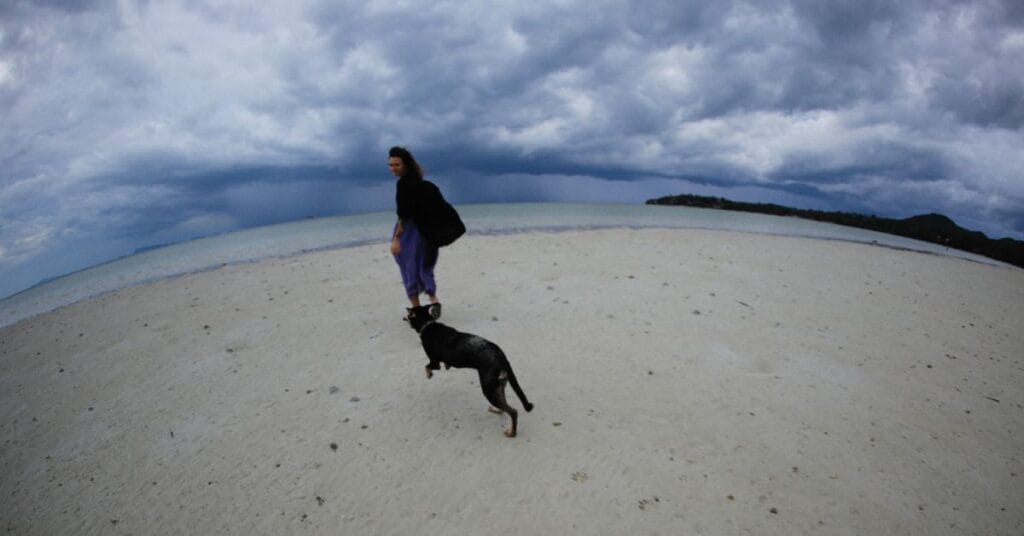
You get up to make coffee, and your dog follows you into the kitchen. You walk to the bathroom, and there they are again. You move from the couch to another room, and within seconds, you hear paws coming up behind you.
Table of Contents
If this sounds familiar, you may be wondering: Why does my dog follow me everywhere?
In most cases, a dog following you around is completely normal. Dogs are highly social animals, and many naturally prefer being close to the people they trust. Your dog may follow you because they enjoy your company, expect something rewarding to happen, feel safer near you, or have simply developed a habit of keeping track of where you are.
Some dogs are so attached to their owners that they’re informally called “Velcro dogs.” However, following you doesn’t automatically mean your dog has separation anxiety.
Occasionally, a sudden increase in clinginess can also be associated with stress, aging, discomfort, or another health problem. Understanding how and when your dog follows you can help you determine whether you’re seeing ordinary affection or something worth discussing with your veterinarian.
Why Does My Dog Follow Me Everywhere?
The most common reasons dogs follow their owners everywhere include:
- They enjoy being near you.
- You’ve unintentionally rewarded the behavior.
- They expect food, walks, play, or attention.
- They feel safer around you.
- They’re curious about what you’re doing.
- Their personality makes them naturally clingy.
- They don’t have enough independent activities.
- They’re experiencing stress or anxiety.
- Age-related changes are making them more dependent.
- They’re experiencing discomfort or another health issue.
The exact explanation depends on your dog’s age, personality, routine, body language, and whether the behavior is new or something they’ve always done.
Let’s look more closely at each possibility.
1. Your Dog Simply Likes Being With You
Sometimes the simplest explanation is the right one: your dog follows you because they like you.
Dogs develop strong social relationships with the people in their household. You provide food, safety, attention, exercise, play, affection, and access to many of the things your dog enjoys.
Naturally, being close to you can become rewarding.
A relaxed dog who follows you around may:
- Walk casually behind you
- Lie down once you stop moving
- Have relaxed ears and facial muscles
- Leave you occasionally to sleep, eat, or investigate something
- Remain calm when you’re in another room
- Be able to stay home without becoming distressed
If that describes your dog, there usually isn’t anything to worry about.
Your dog may also enjoy being physically close to you when you’re sitting or relaxing. If yours frequently climbs onto you rather than simply sitting nearby, you can read our guide explaining why dogs lay on their owners.
2. Following You Has Been Rewarded
Dogs quickly learn which behaviors produce good outcomes.
Imagine that your dog follows you into the kitchen and receives a small piece of chicken. Later, they follow you to the couch and get petted. Then they follow you outside and get to play.
From your dog’s perspective, following you is a very successful strategy.
Even something as simple as talking to your dog when they appear can reinforce the behavior if your dog values your attention.
The American Kennel Club notes that positive reinforcement can contribute to dogs following their owners because staying near a person may repeatedly lead to attention, affection, treats, or other rewards.
That doesn’t mean you’ve done anything wrong. It simply explains how a normal behavior can become a strong habit.
3. Your Dog Thinks Something Good Is About to Happen
Dogs are excellent observers of routines.
Your dog may know that:
- Walking toward the pantry means treats could appear.
- Putting on sneakers means a walk may happen.
- Walking toward the back door could mean outside time.
- Going into the kitchen could mean food.
- Picking up a certain bag means you’re leaving.
- Sitting in a particular chair means cuddle time.
Your movements provide information.
So your dog isn’t necessarily thinking, “I can’t survive unless I’m next to my human.”
They may simply be thinking, “Where are you going, and is something interesting about to happen?”
If your dog seems especially interested whenever activities begin, providing more structured interaction can help satisfy that curiosity. See our guide on how to play with your dog for ideas.
4. Your Dog Feels Safe Around You
Dogs can use familiar people as sources of security.
This tendency may become more noticeable when something in the environment makes your dog uncertain.
For example, your dog might follow you more closely during:
- Thunderstorms
- Fireworks
- Construction noise
- Houseguests
- Travel
- Moving to a new home
- Changes in household routines
- Encounters with unfamiliar people or animals
Watch the rest of your dog’s body language.
A dog who is simply enjoying your company may appear loose and relaxed. A frightened or stressed dog may display behaviors such as trembling, pacing, hiding, excessive panting, lip licking, or difficulty settling.
If panting is one of the behaviors you’ve noticed, DogsScope also explains common reasons why dogs pant.
5. Your Dog Is Curious
Imagine how much of your dog’s world depends on you.
You open doors. You bring food into the house. You introduce new objects. You determine when walks happen. You receive visitors. You disappear through doors and return carrying interesting bags.
Following you gives your dog information about what’s happening.
Curiosity is an especially likely explanation when your dog follows you briefly but has no problem leaving again when something more interesting appears.
A dog who abandons you immediately because someone opened the refrigerator probably isn’t experiencing an unhealthy attachment.
They’re just keeping their options open.
6. Your Dog May Naturally Be a “Velcro Dog”
Some dogs simply prefer being closer to humans than others.
Personality plays a major role, and breed tendencies may contribute as well. Dogs developed to work closely alongside people—such as certain herding and working dogs—may be particularly attentive to human movement and direction. The AKC notes that genetics and a breed’s working history can contribute to this type of close-following behavior.
However, breed alone can’t predict whether an individual dog will follow you everywhere.
Two dogs of the same breed can have completely different personalities. One may spend the entire day beside its owner while another happily sleeps in another room.
Early experiences, training, household routines, age, and individual temperament all matter.
7. Your Dog Is Bored
Sometimes your dog follows you because, frankly, you’re the most interesting thing happening in the house.
Dogs need opportunities for both physical exercise and mental engagement.
Depending on your dog’s health, age, breed, and energy level, enrichment might include:
- Sniffing walks
- Fetch
- Tug
- Food puzzles
- Training sessions
- Hide-and-seek
- Searching for treats
- Safe chew activities
- Exploring new walking routes
- Interactive play
Adequate enrichment may make it easier for your dog to relax independently rather than monitoring everything you do.
This doesn’t mean exhausting your dog until they’re too tired to move. Physical activity should be appropriate for the individual dog, and mental enrichment is just as valuable.
8. Your Dog Might Be Anxious
Anxiety can cause some dogs to seek constant proximity to their owners.
But it’s important not to diagnose separation anxiety simply because your dog follows you to the bathroom.
Velcro dog vs. separation anxiety
A Velcro dog prefers being near you.
A dog with separation anxiety experiences significant distress related to being separated from an attachment figure.
According to VCA Animal Hospitals, dogs with separation anxiety may follow their owners from room to room, but more important signs occur around actual departures and periods of separation. These can include vocalizing, destructive behavior, house soiling, shaking, restlessness, salivating, or refusing food.
The ASPCA similarly describes behaviors such as persistent barking or howling, destructive escape attempts, pacing, house soiling, and anxiety when an owner prepares to leave as possible signs of separation anxiety.
You can read the ASPCA guide to separation anxiety in dogs for additional information.
A simple way to think about the difference
If your dog follows you around but peacefully naps when you leave the house, they’re probably not displaying the classic pattern associated with separation anxiety.
If your dog becomes panicked when you reach for your keys, scratches doors after you leave, howls continuously, destroys exit areas, or cannot settle when alone, that’s different.
A home camera can sometimes help owners observe what actually happens after they leave.
9. Senior Dogs May Become More Clingy
If your older dog suddenly follows you everywhere, aging should be considered.
Older dogs can experience changes in:
- Vision
- Hearing
- Mobility
- Confidence
- Sleep patterns
- Cognitive function
Losing some ability to see or hear what’s happening around them can make staying close to a familiar person feel safer.
Some senior dogs also develop canine cognitive dysfunction syndrome, an age-related condition associated with behavioral and cognitive changes.
VCA notes that dogs experiencing cognitive dysfunction may show changes in social interaction and can become more clingy or demanding. Other signs can include disorientation, altered sleep-wake cycles, house soiling, and changes in previously learned behavior.
Clinginess by itself does not mean your dog has cognitive dysfunction. However, new clinginess combined with confusion or other behavioral changes deserves veterinary attention.
10. Your Dog May Not Feel Well
A sudden personality change should always get your attention.
Some dogs withdraw when they feel sick or painful. Others do the opposite and seek more contact with their owners.
If your normally independent dog suddenly refuses to leave your side, look for additional changes such as:
- Reduced appetite
- Vomiting
- Diarrhea
- Limping
- Difficulty standing up
- Restlessness
- Shaking
- Excessive panting
- Changes in urination
- Changes in bowel movements
- Whining
- Reduced interest in walks
- Unusual aggression
- Sleeping more than usual
- Difficulty getting comfortable
Behavioral changes can sometimes be one of the first signs that something isn’t right.
VCA recommends veterinary evaluation when pets develop significant behavioral changes because medical conditions can influence behavior.
If your dog’s following behavior appeared suddenly—particularly if accompanied by physical symptoms—contact your veterinarian.
Why Does My Dog Follow Me and Not Anyone Else?
It’s common for a dog to follow one household member more than everyone else.
That person may be the one who:
- Feeds the dog most often
- Provides treats
- Goes on walks
- Plays with the dog
- Handles training
- Spends the most time at home
- Provides comfort during stressful situations
Your dog may therefore associate one particular person with most of life’s valuable resources.
Personality matters too.
A quiet dog might feel more comfortable following the calmest person in the household. An energetic dog might prefer whoever plays with them most often.
Previous experiences can also influence attachment.
This doesn’t necessarily mean your dog “loves” one family member more than everyone else. Different people can simply have different relationships with the same dog.
Interestingly, dogs sometimes show the opposite behavior and become distant from an owner. If your dog’s behavior has changed in that direction, see why your dog may be ignoring you.
Why Does My Dog Follow Me Into the Bathroom?
Few places reveal a dog’s commitment to following you quite like the bathroom.
Your dog doesn’t understand that humans generally prefer bathroom privacy. From their perspective, you walked somewhere, and following you is what they normally do.
Your dog might enter the bathroom because:
- Following you has become habitual.
- They’re curious about where you’re going.
- They expect attention.
- They don’t like being separated from you.
- They simply prefer resting near you.
If your dog calmly follows you in and lies on the floor, there’s usually no reason to be concerned.
You can establish boundaries if you prefer privacy. Close the door and provide your dog with another comfortable place to rest.
Why Does My Dog Follow Me From Room to Room?
Dogs that track their owners from room to room are often monitoring the household routine.
Consider what happens when you finally stop moving.
If your dog follows you into the living room and immediately falls asleep, they’re probably using your location to choose their resting place.
Some dogs choose particularly sheltered places near their owners. For example, yours may frequently settle underneath your seat. We’ve covered several explanations in our article about why dogs sit under their owner’s chair.
Why Is My Dog Suddenly Following Me Everywhere?
Sudden clinginess deserves more attention than a lifelong habit.
Start by asking what has recently changed.
Did you:
- Move?
- Change jobs?
- Start working from home?
- Return to working outside the home?
- Add another pet?
- Welcome a baby?
- Lose a household member?
- Change your dog’s schedule?
- Have construction or loud noises nearby?
Changes in environment and routine can affect canine behavior.
The ASPCA notes that changes in guardians, schedules, residences, and household membership can be associated with the development of separation-related problems in some dogs.
If there hasn’t been an obvious environmental explanation, consider your dog’s health—especially if the behavior changed rapidly.
Is It Bad If My Dog Follows Me Everywhere?
Not necessarily.
There’s nothing inherently wrong with having a dog who loves staying close to you.
The important question is whether your dog can function comfortably without constantly touching or watching you.
A healthy attachment might look like this:
Your dog enjoys following you around but can also rest in another room, interact with other family members, play independently, and remain reasonably calm when you leave.
A potentially problematic attachment might involve:
- Panic when you leave
- Inability to settle without you
- Constant whining for access to you
- Scratching or destroying doors
- Refusing food when alone
- Extreme pacing
- Excessive drooling
- Escape attempts
- House soiling associated specifically with departures
Those behaviors suggest the issue is more than simple companionship.
Should I Stop My Dog From Following Me?
If the behavior doesn’t bother you and your dog can cope with reasonable periods of independence, there’s no need to stop it completely.
Being close to you is part of the relationship many people enjoy having with dogs.
However, teaching your dog that being apart from you is also safe can be beneficial.
The goal isn’t to make your dog less attached.
It’s to help them become comfortably independent.
How to Encourage Your Dog to Be More Independent
If your dog follows every move you make and you’d like to create a little more space, these strategies can help.
1. Reward independent relaxation
Don’t reserve all your attention for moments when your dog is standing beside you.
If you notice your dog peacefully resting in their bed or relaxing across the room, calmly reinforce that behavior.
This helps teach:
“Relaxing over here is rewarding too.”
2. Create a comfortable resting area
Give your dog an appealing place to relax that isn’t directly attached to you.
It could include:
- A comfortable dog bed
- A favorite blanket
- Safe toys
- A quiet area
- A chew or food puzzle when appropriate
Position it where your dog can initially see you.
You can gradually encourage more distance as your dog becomes comfortable.
3. Teach a place or settle behavior
A trained “place” cue can teach your dog to relax on a bed or mat while you move around.
Start close to your dog and reward calm behavior.
Gradually increase how much you move and how far away you go.
The goal isn’t to force isolation. You’re teaching your dog that your movement doesn’t always require their participation.
4. Provide independent enrichment
Food puzzles, sniffing activities, appropriate chews, and other enrichment can give your dog something enjoyable to do without constant human interaction.
Choose activities that are safe for your dog and supervise when necessary.
5. Let other household members participate
If your dog follows only you, have other family members become more involved where appropriate.
They could take turns with:
- Feeding
- Walking
- Training
- Playing
- Giving enrichment
This can help prevent every positive experience from being associated with a single person.
6. Practice short, comfortable separations
If your dog isn’t showing severe anxiety, you can practice being briefly out of sight.
Walk into another room for a few seconds and return while your dog remains calm.
Gradually increase the duration.
Avoid dramatically increasing the difficulty. The objective is for separation to remain ordinary and uneventful.
For dogs with significant separation anxiety, however, treatment is more complex. The ASPCA explains that desensitization needs to progress carefully because exposing a dog to more separation than they can tolerate can worsen fear.
7. Don’t punish clinginess
Scolding your dog for following you can increase uncertainty or anxiety.
Instead, show them what you want them to do.
Reward settling.
Provide an alternative location.
Build confidence gradually.
If anxiety is driving the behavior, punishment does not address the underlying emotional problem and can potentially make the situation worse. The ASPCA specifically advises against punishing dogs for behaviors caused by separation-related distress.
What If My Dog Has Separation Anxiety?
Separation anxiety can be challenging, but help is available.
Start with your veterinarian. Medical conditions should sometimes be ruled out before assuming a behavioral cause.
Depending on severity, management may involve carefully structured behavior modification, changes to the dog’s routine, environmental management, and—in some cases—medication prescribed by a veterinarian.
For significant cases, consider working with a veterinary behavior specialist.
The American College of Veterinary Behaviorists directory can help U.S. dog owners locate board-certified veterinary behaviorists.
Don’t try to “teach your dog a lesson” by suddenly leaving an extremely anxious dog alone for long periods. Dogs experiencing genuine separation anxiety aren’t misbehaving out of spite; they’re experiencing distress.
When Should You Call a Veterinarian?
Following you around doesn’t usually require a vet appointment when it’s normal behavior for your dog.
Contact your veterinarian if the clinginess:
- Started suddenly
- Is becoming progressively more intense
- Occurs alongside appetite changes
- Comes with vomiting or diarrhea
- Is accompanied by limping or signs of pain
- Comes with excessive panting or shaking
- Is accompanied by confusion
- Appears alongside nighttime restlessness
- Develops in an older dog along with other personality changes
- Is associated with sudden aggression
- Is accompanied by changes in drinking, urination, or bowel habits
You should also seek professional help if your dog becomes highly distressed when left alone or risks injuring themselves while attempting to escape.
Frequently Asked Questions
Why does my dog follow me everywhere but not my spouse?
Your dog may associate you more strongly with food, walks, play, training, comfort, or other rewarding activities. Dogs can develop different relationships with individual household members, so following one person more than another doesn’t necessarily indicate a problem.
Does my dog follow me because they love me?
Affection and social attachment can certainly contribute. However, dogs also follow people because of habits, reinforcement, curiosity, expectations, security, and routine. It’s usually impossible to reduce the behavior to a single motivation.
Why does my puppy follow me everywhere?
Puppies are learning how their new environment works and often depend heavily on the people caring for them. Following you helps a puppy stay close to safety while learning routines and discovering where interesting things happen.
It’s still useful to gradually teach puppies that short periods of safe independence are normal.
Why does my senior dog suddenly follow me everywhere?
Senior dogs may become more dependent because of changes in hearing, vision, mobility, anxiety, or cognitive function. Sudden behavioral changes in an older dog should be discussed with a veterinarian, particularly if you also notice confusion, altered sleep, house soiling, pain, or other unusual behavior.
Why does my dog follow me everywhere and stare at me?
Your dog may be watching for cues about what you’re going to do next. Dogs learn that human movements, facial expressions, and routines often predict food, walks, attention, play, and other important events.
Why does my dog follow me everywhere and whine?
Whining adds another clue. Your dog might want attention, food, outdoor access, play, reassurance, or relief from discomfort. Anxiety can also cause both clinginess and vocalization.
If the whining is new, persistent, or accompanied by physical symptoms, contact your veterinarian.
Why does my dog follow me everywhere after I come home?
Your dog may simply be excited to have you back. If you’ve been away for several hours, they’ve had less interaction and stimulation than when you’re home.
Extreme greetings combined with panic while you’re gone, however, can be associated with separation-related distress.
Should I ignore my dog when they follow me?
You don’t need to ignore your dog simply because they enjoy your company.
If you’d like to reduce constant following, focus on rewarding calm independence rather than withholding all affection. Give attention when your dog is relaxing appropriately, teach a settle behavior, and provide enjoyable activities they can do without standing next to you.
Final Thoughts
So, why does your dog follow you everywhere?
For most dogs, the answer is reassuringly simple: you’re an important part of their world.
You provide companionship, safety, food, walks, entertainment, affection, and information about what’s happening next. Following you can therefore be an entirely normal part of your dog’s relationship with you.
Some dogs are naturally more “Velcro-like” than others, and there’s nothing wrong with enjoying that close bond.
What matters is your dog’s emotional state.
If your dog can relax when you’re busy, spend some time independently, and remain reasonably comfortable when you leave, following you around usually isn’t a cause for concern.
On the other hand, sudden clinginess, major behavioral changes, signs of illness, confusion in a senior dog, or panic during separation deserve closer attention.
Watch the whole dog rather than focusing only on the following behavior.
Your dog’s posture, routine, health, age, and behavior when you’re actually absent will tell you much more about whether those footsteps behind you simply mean, “I like being with you,” or whether your dog needs additional support.